
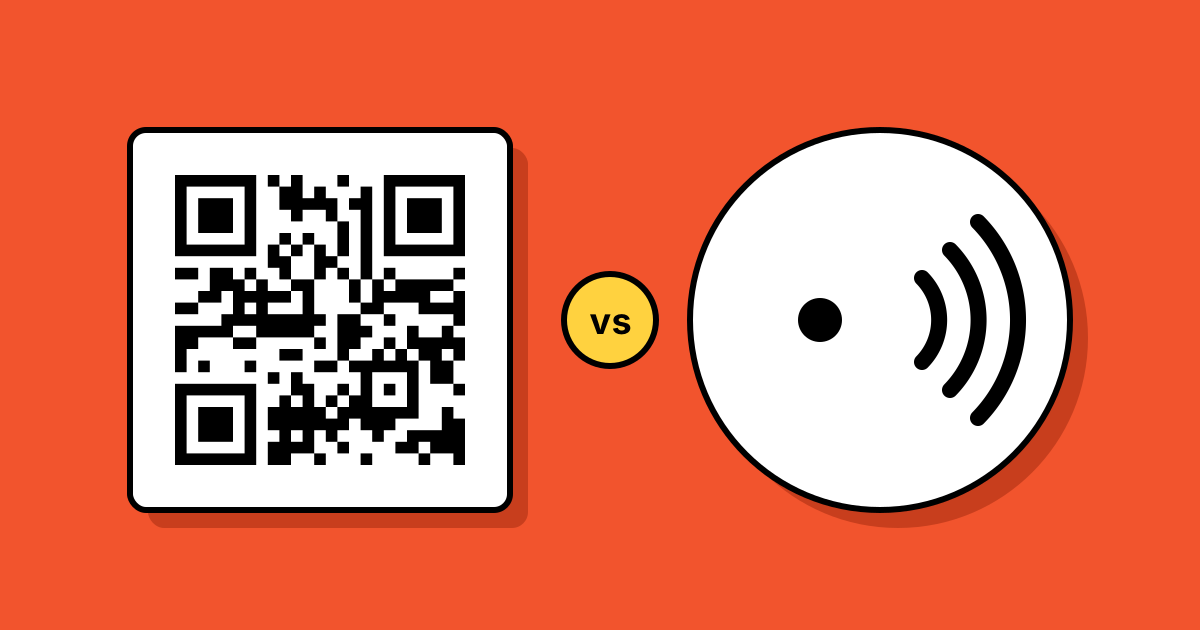
Short answerUse a QR code when you need something cheap to print, visible, and readable from a distance by any phone with a camera. Use NFC when a quick tap at very close range suits the moment and the cost of a tag per item is acceptable. Many products carry both, pointing to the same link.
Side by side
| QR code | NFC tag | |
|---|---|---|
| What it is | A printed pattern | A small chip with an antenna, in a sticker, card or product |
| How it’s read | The phone’s camera | Holding the phone against it |
| Range | From a few centimetres to many metres, depending on size | A few centimetres |
| Cost | Free to make; only the cost of printing | A cost for every tag |
| Works on a screen or in a photo | Yes | No |
| Can be seen | Yes, people know something is there | No, it needs a label that says “tap here” |
| Needs power | No | No. The phone powers the tag |
How each one works
A QR code stores text, usually a web address, as a grid of squares. Any phone camera reads it. There is more on this in what is a QR code?
NFC stands for near field communication. A tag holds a small amount of data, also usually a web address. When a phone with NFC is held within a few centimetres, it powers the tag by radio, reads the address and offers to open it. It is the same technology used for contactless card payments.
Where a QR code is the better choice
- Anything printed in volume: packaging, flyers, menus, receipts. Adding a code costs nothing extra per item.
- Anything read from a distance: posters, signs, shop windows, slides.
- Screens: a code can be shown on a TV, a presentation or a website.
- Every phone: a camera is all it takes, with no setting to turn on.
Where NFC is the better choice
- Things people already touch with their phone: a counter stand, a card reader, a door.
- Small or dark surfaces where a code won’t fit or the camera can’t see it.
- Items you hand to someone: a tap-to-share business card, a wristband, a key fob.
- When appearance matters and a printed code would spoil the design. The tag can sit under the surface, though it still needs a mark that shows where to tap.
Limits to know about
- NFC isn’t on every phone. Most phones sold in recent years have it, but some budget models don’t, and on some phones it has to be switched on first.
- NFC tags don’t like metal. Standard tags fail on metal surfaces; special tags made for metal cost more.
- People don’t always know to tap. A QR code is recognised on sight. A tag needs a clear “tap your phone here”.
- QR codes need light and a clear view. Glare, dirt or a dim room can stop a scan. See where to put a QR code.
Using both together
You don’t have to choose. A table stand, a product or a card can carry a printed code and a tag, so people use whichever is quicker for them. Point both at the same destination.
If that destination is a dynamic short link, you can change where it goes later without reprinting the code or rewriting the tag. Scans through the link are counted either way, though the count won’t tell you whether a visit came from a scan or a tap unless you give the tag its own link. How dynamic links work is in static vs dynamic QR codes.
Is one safer than the other?
Both simply deliver a link, and the risk is the same: a link you didn’t expect. A sticker can be placed over a real code, and a rogue tag can be stuck over a real one. In both cases, read the address your phone shows before you open it. The checks are in are QR codes safe?
FAQ
Questions people ask
Can’t find yours? A person answers every email within 2 working days.
Email usIs NFC better than a QR code?
Neither is better in general. NFC is quicker at touching distance; a QR code is cheaper, visible, and works from far away and on screens.
Do all phones have NFC?
No. Most recent phones do, but some lower-cost models don’t, and it can be switched off. Every phone with a camera can read a QR code.
Can an NFC tag and a QR code open the same page?
Yes. Put the same link in both. A dynamic short link lets you change the destination for both at once.
Which is cheaper?
A QR code. It is free to make and adds nothing to the print cost. Every NFC tag has to be bought.